Critical Cooling

Precision cooling solutions for data centers and mission-critical environments

CHILLERS FOR COMPUTER ROOMS, SERVER ROOMS & DATA CENTERS

As the data center industry becomes more energy conscious, mechanical chillers have come under fire. The attention is warranted, for chillers represent the most energy intensive component in the entire cooling process.
Despite this pariah status in efficiency circles, chillers are essential to keeping data centers cool. And, through good engineering and planning, they can be optimized.

CHILLER BASICS

Chillers use the refrigeration process to create chilled water, supplied through a series of pumps and valves to computer room air conditioners. The water circulates through the cooling coil, where it accepts heat generated by the IT equipment and returns to the chiller to be cooled. This perpetual cycle is supported through a series of interconnected parts in the chiller: an evaporator, a compressor, and a condenser.
Chiller efficiency is measured in kW/ton, a ratio that compares the energy required by the chiller to produce a ton of cooling.
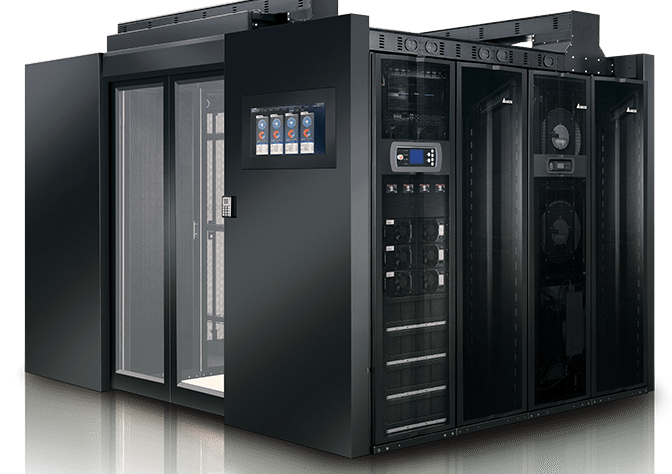
COOL
CHILLER OPTIMIZATION: FREE COOLING

In reality, free cooling is not without costs. But it can be extremely effective. Free cooling uses the environment to produce cooling. And economizers are the tools of the trade. A water side economizer uses outside air, instead of refrigeration, to supply chilled water to computer room air conditioners. An air-side economizer introduces outside air to the data center whenever the temperature is appropriate, replacing continuous air conditioning.
Since data centers work days, nights, weekends, and holidays, nearly all geographies can attain some savings through free cooling. Those with the most temperate environments, however, will see the largest returns.

CHILLER OPTIMIZATION: MAXIMIZING DELTA T

Delta T is a key design setpoint for any heat exchanging device. Chillers and air conditioners operate more efficiently as Delta-T equals (or sometimes exceeds) this setpoint. So, how can users impact it?

Computer Room Air Condition

Proton computer room cooling solution specialists have the product knowledge and application experience to optimize your server room environment:
• We have retrofitted office spaces into high – density computer rooms.
• We have turned cooling / power strapped computer rooms into scalable, optimized server rooms.
• We tailor unique cooling solutions to your computer room environment and objectives.
SERVER ROOM COOLING SYSTEMS FOR SMALLER SPACES
Comfort cooling (or building HVAC) lacks the precision and required for modern server room hardware. Yet, closets, computer rooms, and server rooms do not have the space to install traditional, bulky air conditioners. The products featured below are specifically engineered for smaller room spaces.

HIGH-DENSITY COMPUTER ROOM COOLING
Today, it is possible. Technologies normally marketed for enterprise data centers can now fit nicely into smaller spaces. Self-contained cooling unites, for instance, function independently of the room. Once installed, users have the comfort of predictable cooling and plenty of headroom for future growth.
THE PROTON ADVANTAGE
Proton sales engineers conduct thorough pre-sales interviews so that we understand unique client issues, applications, environmental factors and actual usage. We use this information to design and recommend the best server room cooling solution for our clients.
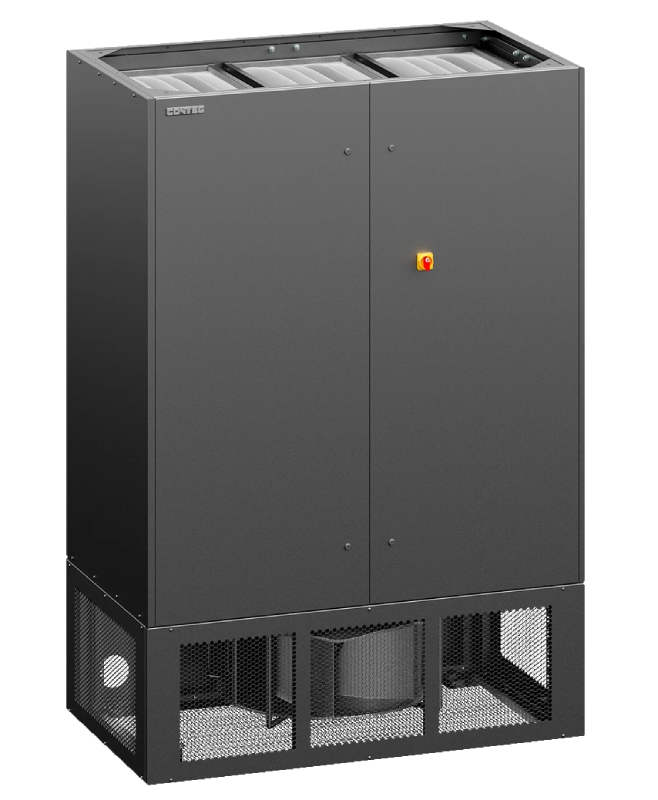
Computer room air conditioners / air handlers are a staple of data center design, providing precise temperature and humidity control for mission critical environments. Engineered for 24x7x365 operation, CRACs provide recurrent, cooling it, and returning it back to the equipment.
Traditional data center cooling has used CRAC / CRAH units and a raised floor plenum (like below) to distribute chilled air to data center racks.
CRAC / CRAH view from cold aisle – Computer room air conditioner & raised floor plenum 
CRAC / CRAH – computer room air conditioning considerations 
ENVIRONMENTAL CONTROL  
CRACs supply chilled air (measured in cubic feet per minute) within a specific temperature range (the current ASHRAE specification is 64.4 deg F to 80.6 deg f ) to satisfy the cooling demands of IT equipment. CRACs have design specifications for supply air , return air , and refrigerant temperature , all of which affect its operation and performance.
CAPACITY
Capacities for CRAC and CRAH units are typically measured in tons, which can be converted to kilowatts (KW) or British thermal units (btu/hr) depending on user preference.
CRAC VS. CRAH
Though they serve the same purpose, there is a fundamental difference between a CRAC and CRAH:
• A Computer Room Air Conditioner includes an internal compressor, using the direct expansion of refrigerant to remove heat from the data center.
• A Computer Room Air Handler includes only fans and a cooling coil, often using chilled water to remove heat from the data center.
HEAT REJECTION 
Both technologies will require outdoor heat rejection sources. CRAC units are connecting to remote condensers, while CRAH units are traditionally connecting to chiller systems.

Indoor Cooling

Indoor cooling solutions are designed to maintain optimal environmental conditions inside computer rooms, server rooms, and data centers. IT equipment such as servers, storage systems, and networking devices generates significant heat during operation, and effective cooling is essential to ensure stable performance and prevent hardware failures.
Precision indoor cooling systems regulate temperature, humidity, and airflow within the facility, ensuring that heat generated by IT equipment is efficiently removed. Unlike standard air-conditioning systems, these solutions are specifically engineered for mission-critical environments where reliability and continuous operation are essential.

Indoor Cooling
Cabinets Cooling
Cabinets Cooling

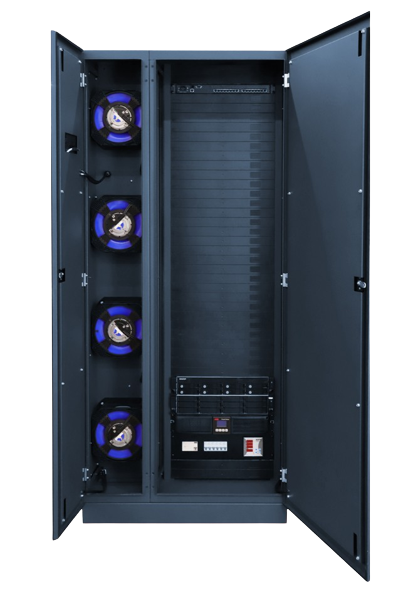
Many data centers historically didn’t put much more thought into deployment of server racks beyond basic functionality and the upfront costs of the rack itself . when compared to a data centers complex mechanical, electronic al , and technical systems , a server rack is low on the totem pole of strategic commodities. But this perception is belied by a few simple facts. Server racks house millions of dollars worth of hardware, safeguarding all processed data, transaction, and intellectual property they are the definition of “physical” Infrastructure –welded steel that serves as your enterprises last line of physical security. Finally, and most importantly, no cooling approach can exist without taking the server rack into account.
SERVER RACK COOLING Rack Cooling Solution
The only ASHRAE temperature standard at the equipment inlet-the front door of the rack. While the cooling process does not necessarily start there, nowhere is it more important. IT professionals, when considering a rack manufacturer and product, need to understand how that product contributes to productive cooling.
HOT AISLE / COLD AISLE CONTAINMENT WEBINAR REPLAY SERVER RACK CONSIDERATIONS 
Space utilization, flexibility, and lead-time are also important rack talking points. The following recommendations speak to these points.
INSTALL THE MAXIMUM FOOTPRINT POSSIBLE
Servers continually get smaller and more powerful. Meanwhile, the support requirements at the rack level continue to increase more power circuits, larger whips, more cables to manage. Installing the maximum practical footprint, in terms of width and depth, provides the most flexibility in the future for ever-changing hardware requirements.
The rack footprint, of course, must be weighed alongside real estate policies and costs. Data center floor space is expensive, and larger cabinets will consume more of it.

Outdoor Cabinets Cooling

Reliable Cooling for Outdoor Infrastructure
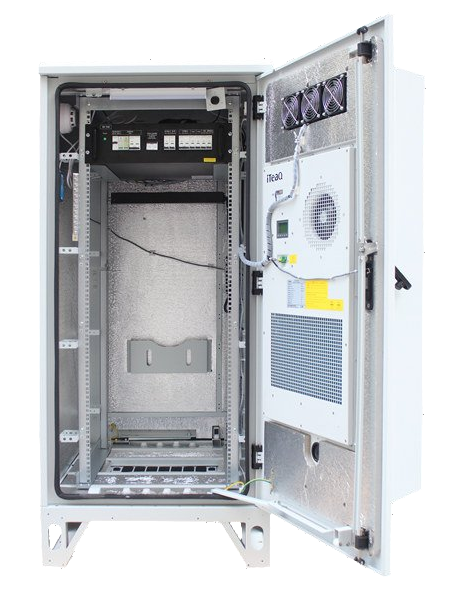
Outdoor cabinet cooling solutions are designed to maintain safe operating temperatures for equipment installed in outdoor environments such as telecom sites, network stations, and industrial control systems. These systems protect sensitive electronics from overheating caused by high ambient temperatures, solar radiation, and continuous equipment operation. Effective cooling ensures reliable performance and prevents system failures.
Efficient Climate Control in Harsh Conditions
Outdoor cooling systems may include cabinet air conditioners, heat exchangers, or ventilation systems that remove heat and maintain a stable internal environment. These solutions are engineered to operate in harsh weather conditions while protecting equipment from dust, humidity, and temperature fluctuations, ensuring long-term stability and efficiency.

Outdoor Cabinets Cooling